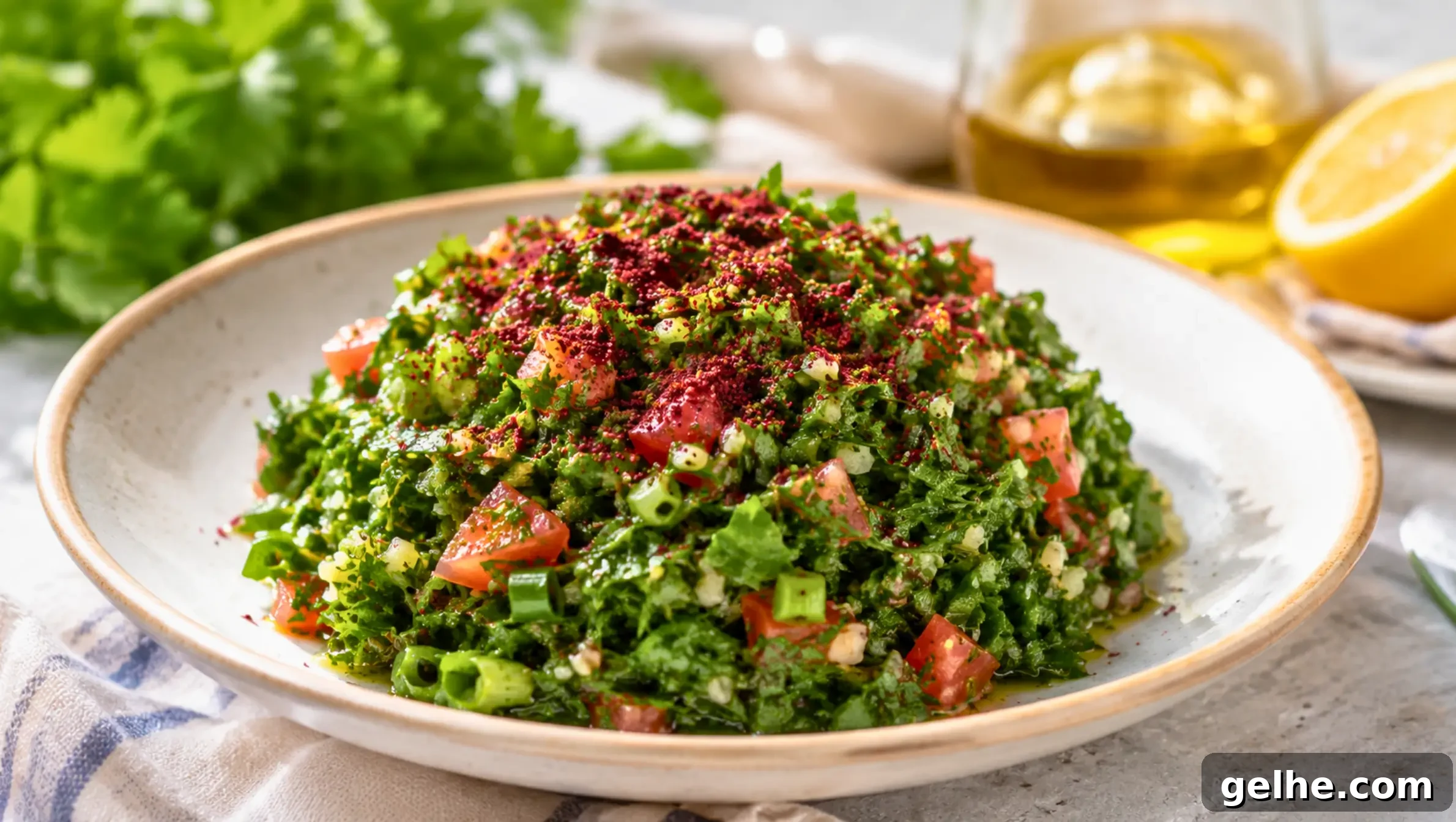
Why this tabbouleh has almost no bulgur
Forget the coarse semolina found in supermarket tabbouleh.
Lebanese tabbouleh is first and foremost an herb salad, where flat-leaf parsley plays the leading role, brightened with a little mint and green onion. Bulgur appears only in very small quantity here — about 10 g — simply to add a bit of grain and chew. By contrast, the French-style version, often drowned in semolina, tends to be denser and pastier.
The result is a vivid, light green salad that smells more like the garden than the pantry.
Bulgur soaked in tomato juice, not water
The key change comes from how you treat the bulgur. Instead of rehydrating it with water, let it swell in the tomato juice obtained by pressing the pulp. This allows the grains to absorb flavor from the start, rather than remaining neutral. An hour is enough for the bulgur to soften without becoming mushy.
Nothing is wasted: the tomato flesh is cut into cubes while the juice perfumes both the bulgur and the vinaigrette.
Ingredients for Jean-François Piège’s Lebanese tabbouleh
Serves 4.
- 4 bunches flat-leaf parsley
- 4 mint leaves
- 4 green onions (cébettes)
- 10 g cracked wheat (bulgur)
- 250 g tomatoes
- 60 g lemon juice
- 150 g olive oil
- Sumac
- Four-spice blend that includes cinnamon
- Salt
Steps, from tomato juice to dome presentation
- Cut the tomatoes into cubes, keeping the pulp and interior. Press these parts through a sieve over a bowl to extract the juice.
- Pour most of the tomato juice over the bulgur and let it swell for 1 hour, reserving a little juice for the vinaigrette.
- For the vinaigrette: combine the remaining tomato juice and the lemon juice, season with salt, add a pinch of the four-spice blend and three to four pinches of sumac, whisk until the salt dissolves, then stream in the olive oil while whisking continuously. Adjust seasoning to taste.
- Finely chop the parsley, mint and the green part of the green onions. Place them in a large bowl, add the tomato cubes and the soaked bulgur, season lightly with salt, sprinkle with sumac and add several spoonfuls of vinaigrette.
- Mix the tabbouleh with a spoon to coat the herbs evenly, add more vinaigrette if needed, let rest for 5 minutes, then taste and adjust seasoning.
- Shape into a small dome on a serving plate and finish with a final pinch of sumac just before serving.
The spices that make the trip
The recipe’s signature relies on two condiments. Sumac, a tart Middle Eastern berry, contributes a lemony tang and a garnet hue, while a four-spice blend containing cinnamon adds a warm, slightly sweet undertone. The chef uses sumac at several stages, finishing with a last pinch at plating.
For the fat component, a mild olive oil is preferable to a robust one so it binds the dressing without overpowering the herbs.
Shaped into a small dome and prepared a little ahead, the tabbouleh develops further character as the flavors meld.